
A street strip build asks one carburetor to do two jobs. It needs to idle cleanly on a warm afternoon in traffic, transition smoothly when you crack the throttle off a stoplight, and still pull hard through a full-throttle strip pass.
The single biggest factor in whether a carb can actually do both is whether it's sized correctly for the engine underneath it. Sizing is also where most builders go wrong, usually by buying more carburetor than the engine can use.
PROFORM Parts builds complete carburetors in five CFM sizes covering everything from a mild street small block to a big-inch strip build. Here's how to land on the right one.
Start With the Math, Not the Catalog
CFM demand comes from a simple formula. Engine displacement in cubic inches multiplied by maximum RPM, divided by 3,456. That gives you the theoretical peak airflow demand for your engine.
Then adjust for volumetric efficiency, which is how completely the engine actually fills its cylinders. A stock or mildly built engine runs around 80 percent, so multiply your result by 0.8. A heavily modified engine with good heads, a healthy cam, and a well-matched intake runs closer to 100 percent, and a serious race engine can exceed it.
Run the numbers on a 350 turning 6,000 RPM and you get roughly 608 CFM theoretical. At 85 percent volumetric efficiency, real demand lands around 515 CFM, which a 650 covers with margin to spare. A 383 stroker spinning 6,500 with good heads lands in 750 territory. Big cubic inch builds turning serious RPM are where the 950 and 1050 sizes genuinely earn their place in the lineup.
Why Oversizing Hurts More Than It Helps
The instinct to size up is understandable. Bigger number, more airflow, more power. The problem is that a carburetor meters fuel based on the velocity of air moving through its venturis, and an oversized carb kills that velocity everywhere except peak RPM.
Low air velocity means a weak fuel signal. A weak fuel signal means poor atomization, rough idle, lazy off-idle transition, and a rich mixture at cruise. An 850 CFM carb on an engine that only demands 650 doesn't make more power. It makes the car worse to drive everywhere except the last few hundred RPM of a strip pass, and often not even there.
For most street strip builds, the math lands between 650 and 850 CFM. PROFORM's complete lineup spans 650 to 1050, with the 950 and 1050 units built for high-displacement, strip-focused builds where the engine can genuinely use that much airflow. Match the carb to real demand.
The PROFORM Lineup Across the Range
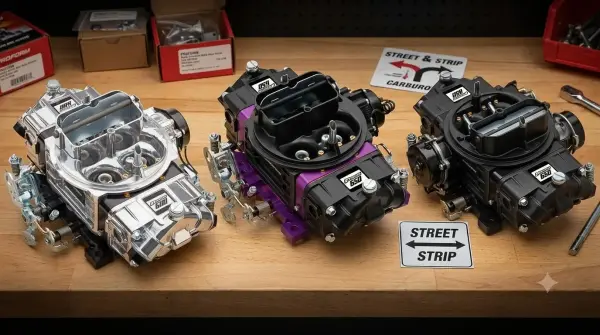
PROFORM's complete carburetors come in five sizes at 650, 750, 850, 950, and 1050 CFM, so wherever the math lands your build, there's a matching unit.
The Race Series covers the full range, anchored by the Next Gen main body design. The 650 CFM Race Series (Part #67199) is the entry point, with the 750 (Part #67200) and 850 (Part #67201) covering the sizes where most street strip builds land. The 950 (Part #67202) and 1050 (Part #67209) handle big-inch, high-RPM applications.
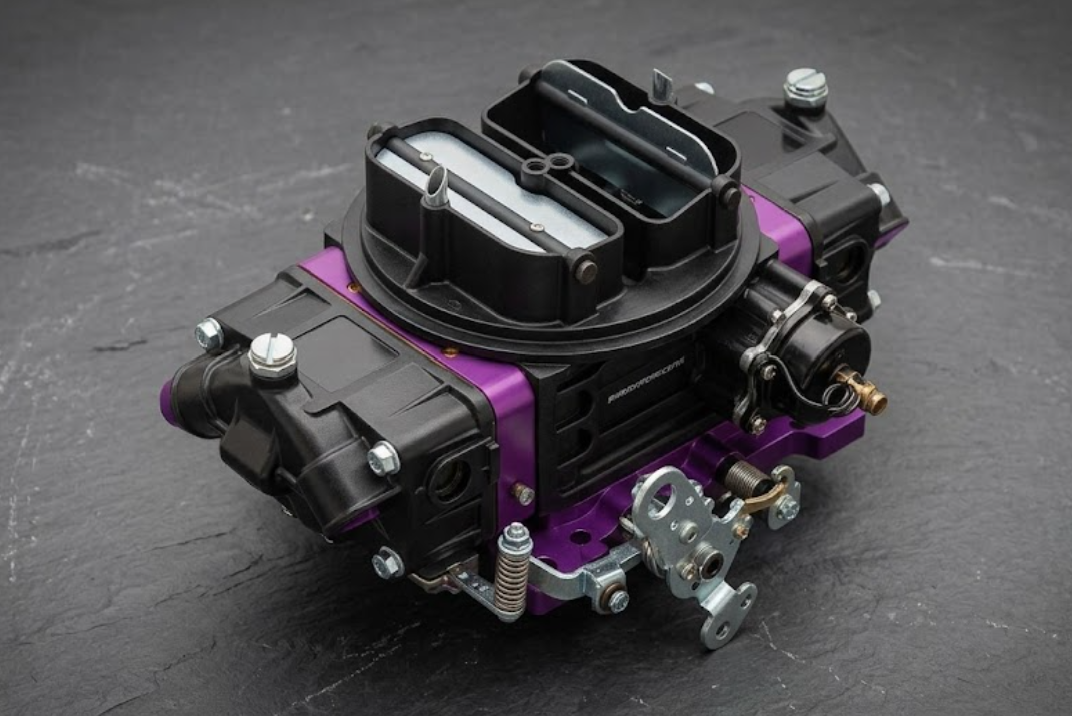
The Black Race Series runs the same five sizes (Parts #67301 through #67305) finished in the Black Diamond® coating for builders who want a murdered-out look under the hood to match a blacked-out engine bay.
Every complete PROFORM carburetor is a dual-inlet four-barrel with mechanical secondaries and a square-type bore mount, assembled with 100% new components, and hand assembled and dyno tested in the U.S.A.
What the Next Gen Main Body Changes
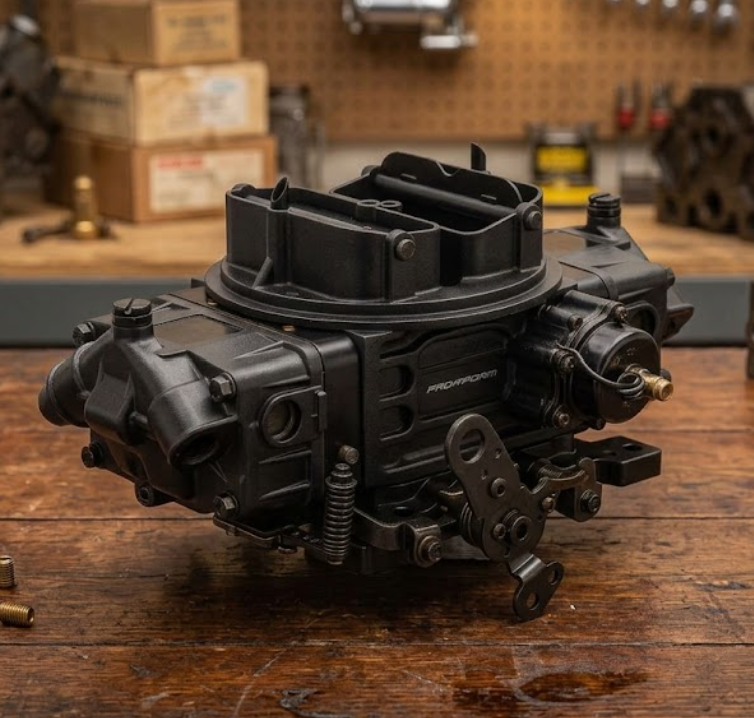
PROFORM's Next Gen Race Series main body is a complete redesign, not a refresh, and it's the reason these carbs punch above their price.
The main body itself pairs contoured venturis with new 2-step down-leg boosters, a combination that creates better airflow and increased fuel atomization. The fuel bowls are a completely new design with increased internal baffling and a lower fuel ramp, and the metering blocks carry a matching baffle that works together with the bowl baffles to reduce fuel slosh and increase control under hard launches. Slabbed throttle shafts for increased airflow are now standard on the throttle base plate.
The tuning hardware is where these carbs really separate from the competition. Adjustable screw-in air bleeds let you fine-tune the fuel curve without drilling permanent changes into the calibration. Torx head squirters, fully adjustable billet aluminum metering blocks, and a billet aluminum throttle base plate that won't warp round out the package. The throttle lever is compatible with Ford kickdown bracketry, and the secondary opening rate can be adjusted with a linkage kit sold separately.
The aluminum fuel bowls use sight glass windows and billet fittings, so float setting is quick and there's no sight plug to remove and no risk of spilling fuel.
Why Mechanical Secondaries
Every complete PROFORM carburetor uses mechanical secondaries, and that's a deliberate choice for performance use. Mechanical secondaries open based on linkage position, which puts the timing entirely in the builder's hands.
On a vacuum secondary carburetor, the secondaries open based on engine demand. That's forgiving for daily driving, but it takes control away from you, and control is exactly what a street strip build needs. On a mechanical secondary carburetor, you decide when the secondaries come in and how aggressively, and you can tune that behavior to match the engine and the track.
The trade-off is that mechanical secondaries reward setup. Secondaries that open before the engine can use the airflow cause a bog. PROFORM's adjustable secondary opening rate keeps that tuning window fully open with a linkage kit sold separately, and the adjustment doesn't require special tools or pulling the carburetor off the manifold.
Boosters, Air Bleeds, and Fine Tuning Features
All complete PROFORM carburetors use down-leg boosters with a 2-step atomization design. Down-leg boosters deliver finer fuel atomization at part throttle while still flowing well at full throttle, which is exactly the balance a street strip carb needs.
For builders who want to convert an existing 4150-style carb to annular boosters, PROFORM offers separate main body upgrades in 750 CFM (Part #67217) and 1050 CFM (Part #67218) with billet aluminum annular boosters. Annular boosters atomize fuel through a ring of holes around the booster instead of a single discharge nozzle, which can sharpen throttle response on some applications. The swap uses your existing metering blocks, fuel bowls, and baseplate, takes under 30 minutes with 14 screws, and can add up to 25-50 HP.
Adjustable screw-in air bleeds are standard across the PROFORM lineup. Air bleeds shape the fuel signal at the booster, and adjustable ones let you fine-tune the fuel curve without drilling permanent calibration changes.
Built Without a Choke, On Purpose
Every complete carburetor in the PROFORM lineup is built without a choke, and that's a design decision, not a missing feature.
A choke exists to enrich the mixture for cold starts, which matters on a daily driver that has to behave on the first crank of a winter morning. A performance build doesn't operate that way. A street strip car gets a proper warm-up before it's asked to work, and a strip car is warmed up before it ever stages.
Deleting the choke pays for itself in airflow and simplicity. No choke tower means a cleaner casting and maximum flow through the primary side, one less vacuum leak point to chase, and less hardware on top of the carb. The Race Series and Black Race Series both follow this formula, so cold-start enrichment hardware never gets between your engine and the airflow it demands at wide-open throttle.
Every PROFORM Carburetor Is 100% New
Not remanufactured. Not refurbished cores with a fresh finish applied.
That matters because a carburetor is a precision metering device. Worn throttle bores, out-of-spec metering passages, or a base plate that's been through someone else's tuning cycles all introduce variables you can't see and can't easily correct. A 100% new carburetor starts from a known baseline every single time.
The Race Series and Black Race Series carbs are hand assembled and dyno tested in the U.S.A. before shipping, so the unit you bolt on has already proven it flows correctly. Run the math, land on your size, and contact us with any application questions.