The Engine Building Tools Most Home Builders Actually Need in the Shop
Wednesday, March 11, 2026
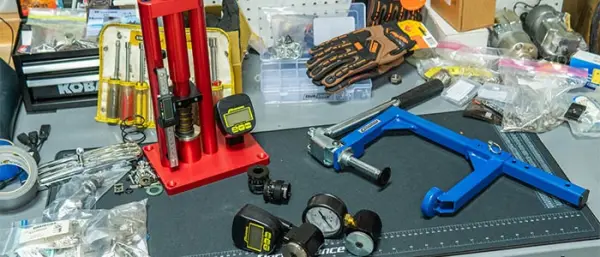
There's a version of engine building where you send everything to a machine shop, pick up a short block, and bolt it together with basic hand tools. That works.
But the more you do in-house, the more control you have over fit, clearances, and ultimately how the engine performs and how long it lasts.
The problem is that engine building tools have historically been priced for professional shops running volume, not for the guy building one motor a year in his garage.
That's changed. Here's what's actually worth having and why.
Piston Ring Tools
Piston ring end gap is one of the most important clearances in the entire engine, and it's one of the few things you can dial in yourself with basic equipment. Rings come from the manufacturer with intentionally tight end gaps that need to be opened up to the correct specification for your bore size, ring material, and intended use.
Too tight and the ring ends butt together as the engine heats up, which destroys rings and can score the cylinder wall. Too loose and you lose compression and blow-by increases.
A manual piston ring filer handles this with a hand crank and a 120-grit grinding wheel. You file a little, drop the ring in the bore, check the gap with feeler gauges, repeat. It takes time but it's not technically difficult. If you're building multiple engines or just want the process to go faster, an electric ring filer does the same job with a motor doing the cranking. ProForm makes both, a manual version and 120V and 220V electric models, plus a 6V adapter version for portable use.
Piston ring compressors are the other essential piston tool. These are the tapered or band-style sleeves that compress the rings so you can tap the piston into the bore without breaking a ring or nicking a cylinder wall. They're sized by bore diameter, so you need one that matches your application. ProForm's lineup covers 4.000"-4.090", 4.125"-4.205", and 4.205"-4.310" ranges, which covers virtually every common V8 bore size including stroked applications.
The piston ring squaring tool is one many builders skip and shouldn't. When you're checking ring end gap, the ring needs to be sitting perfectly square in the bore or your gap measurement is wrong.
A squaring tool uses a piston to push the ring down evenly and seat it parallel to the deck. It's a small thing that eliminates a common source of measurement error.
Valve Spring Tools
Valvetrain work is where casual builders most often get themselves in trouble. Spring pressure and installed height are specs that matter enormously for cam performance and longevity, and there's no good way to verify them by feel.
A valve spring tester measures the actual pressure a spring produces at a given height. This matters when you're installing a new cam and want to confirm your springs are appropriate for the application, and it matters even more when you're reusing springs and want to know if any have taken a set and lost pressure.
ProForm makes several versions, such as a 300 lb. capacity tester for mild applications, a 700 lb. unit for more aggressive setups, and a digital mini tester that reads to 700 lbs. with a digital display for cleaner readouts. RIMAC testers in the ProForm lineup extend that capacity to 1,000 lbs. for serious race applications.
Valve spring compressors are required any time you're changing springs, seals, or keepers. A stud-mount compressor works on the bench or on the head while the head is still on the engine, useful for a quick seal replacement without pulling the head.
The LS-specific compressor from ProForm is designed for the geometry of LS cylinder heads, which require a different approach than a Gen 1 SBC. If you're doing LS work regularly, the dedicated tool is worth it over trying to adapt a universal compressor.
Engine Block Tools
A few block-level tools separate a properly assembled engine from one that's just tight enough to start.
The oil pump primer is the most important one on this list for anyone building a fresh engine. An unprimed oiling system means the engine runs on bare bearings for the first seconds after startup while the pump builds pressure.
On a freshly rebuilt engine with new clearances, that's when you can do real damage. An oil pump primer tool chucks into a drill, drives the pump through the distributor hole (on older engines) or directly on LS applications, and builds full oil pressure before the engine ever fires. ProForm makes application-specific versions for the GM LS, Chevy small block with bushing, and HEMI Gen III engines.
Freeze plug installation tools give you a clean, straight press-in without the hammer-and-socket method that can cock a plug and leave you chasing a slow coolant leak later. The three-piece set covers the common plug sizes.
For LS builders specifically, the LS main cap remover is a legitimate time saver -- the main caps on Gen III/IV LS blocks are stubborn to pull by hand without the right tool, and forcing them risks damaging the block or cap.
The engine rotation adapter deserves a mention too. Being able to turn the engine over by hand during assembly to check for clearance issues, verify timing, or feel for any binding before you fire it is basic practice that's a lot easier with a proper turning adapter in the crank bolt than improvising with whatever's handy.
Harmonic Balancer Tools
Harmonic balancers are pressed onto the crankshaft snout and need to be properly installed and removed. The two main mistakes here are hammering a balancer on (which can damage the crank thrust bearing) and using a jaw puller that pulls on the outer ring of a bonded balancer (which separates the outer ring from the hub, ruining the balancer).
The correct approach is a thread-in installation tool that draws the balancer onto the crank using the crank bolt threads, and a puller designed to pull from the hub rather than the outer ring. ProForm makes these for SBC and BBC, LS-specific applications, and late-model Ford, Chrysler, and other domestic applications that use metric fasteners.
The LS-specific installer is worth calling out because LS engines use a different snout dimension than Gen 1 SBC, and using the wrong tool risks cross-threading into the crank snout, which is a very expensive problem on what is otherwise a very straightforward job.
Putting It Together
None of this is exotic. Ring filing, spring checking, priming the oil system, and installing a balancer correctly are baseline practices for any engine build that's going to run reliably. The tools that make them possible used to mean renting from a machine shop or borrowing from someone with a bigger tool budget. At this point there's no good reason not to own them.