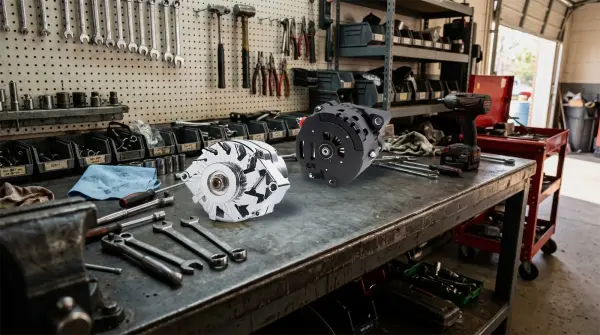

If you've spent any time shopping alternators for a classic build, you've run into the 1-wire vs 3-wire alternator question.
It sounds more complicated than it is, but picking the wrong setup for your application creates real headaches. Either an alternator that won't charge correctly or a wiring job that's messier than it needs to be.
Here's how to think through it.
What the Difference Actually Is
A 3-wire alternator is what came stock on most classic domestic vehicles.
It uses three connections to function: a main output wire to the battery, an exciter wire that signals the alternator to begin charging, and a sensing wire that tells the internal regulator what voltage the system is running so it can regulate output accordingly.
The factory wiring harness was designed around this setup, which is why a 3-wire unit drops straight into a stock restoration with no modifications.
A 1-wire alternator simplifies all of that down to a single connection: the main output wire to the battery.
The internal regulator handles everything automatically once the alternator reaches a certain RPM. No exciter wire, no sensing wire, no connections to the factory harness at all.
When 1-Wire Makes Sense
On a modified build where the factory wiring harness has been stripped, replaced, or heavily modified, a 1-wire alternator is the cleaner solution by a significant margin.
There's no factory harness to tap into, no exciter circuit to track down, and no sensing wire to route. One wire from the output terminal to the battery and you're done.
Our PROFORM 1-wire alternators use an internal regulator that handles voltage regulation automatically.
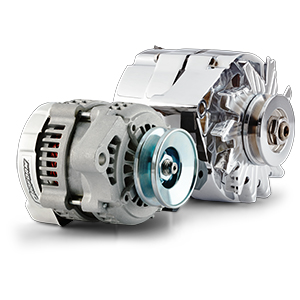
The 50-amp mini alternator is a good example of how clean this can be. 6 lbs., 96mm housing, universal fitment, one wire. For a race car or a stripped-down street machine running a custom harness, that simplicity has real value.
For builds where appearance matters as much as function, our Lightning-Bolt 100-amp mini alternator takes the 1-wire approach further.
It produces 80 or more amps at idle and over 100 amps at the top end from a 7 lb. unit that's nearly 40 percent lighter than a standard 10SI alternator.
The unique aluminum Lightning-Bolt housing is a legitimate visual statement in a finished engine bay, and it includes a billet aluminum adapter kit for direct 10SI mounting, so if you're replacing a stock 10SI unit the swap is straightforward.
When 3-Wire Makes More Sense
On a stock or near-stock restoration where the factory wiring harness is intact, a 3-wire setup works with the existing infrastructure rather than against it.
The sensing wire in a 3-wire system also gives the regulator more accurate voltage information since it's reading system voltage at a point downstream from the alternator rather than just at the output terminal.
On a street car with a full electrical load—lights, ignition, fuel pump, cooling fans—that accuracy can mean tighter voltage regulation across varying loads.
The honest answer is that for most performance builds running a modern wiring setup, 1-wire is the practical choice.
For a correct restoration or a car where the factory harness is staying in place, 3-wire keeps everything working as designed.
Amperage and Application
Wire type is one decision, amperage output is the other. Our alternator lineup runs from 50 amps on the mini units up to 140 amps on the high-output GM 10SI style units, with 60, 80, 100, 110, and 120-amp options in between.
The 80-amp unit in chrome fits small block and big block Chevy V8s in the GM 10SI case style, giving builders a stock-style look with modern 1-wire convenience.
The 140-amp version uses the same 10SI case and fits the same applications, built for builds running more electrical load from fuel injection conversions, electric fans, or other accessories that push demand beyond what a stock-output unit can reliably handle.
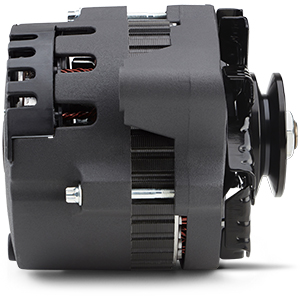
For Chrysler and MOPAR® applications, our officially licensed MOPAR 110-amp alternator fits Chrysler square-back OEM-style applications from 1960 to 1987 covering V8 and Slant Six engines.
Black crinkle finish, 1-wire hookup, factory original case style. It's worth noting this unit is specifically not compatible with 3-wire setups — it's built for the 1-wire conversion and it is intended for Mopar builders choosing a 1-wire conversion.
Case Style Matters for Fitment
The case style, 10SI, CS-130, Lightning-Bolt, and others, determines the mounting configuration and bracket compatibility. If you're bolting into existing brackets on a Chevy small block, the 10SI case style uses the standard mounting points most performance brackets are already designed around.
The Lightning-Bolt unit includes a 10SI adapter kit specifically so it can use those same mounting points despite its unique housing design.
Every PROFORM Alternator is 100% New
All of our alternators are built from 100% new components, not remanufactured cores, not refurbished units.
Each one is produced using specialized equipment, assembled with dedicated jigs by trained personnel, and tested at both the component level and the finished unit level before it ships. Some units even include individual test results in the box.
On a build where you've invested real time and money, a reman alternator with unknown internal wear history isn't worth the few dollars it might save upfront.