Why Slim Fit Radiator Systems Matter in LS and SBC Swaps
Friday, February 20, 2026
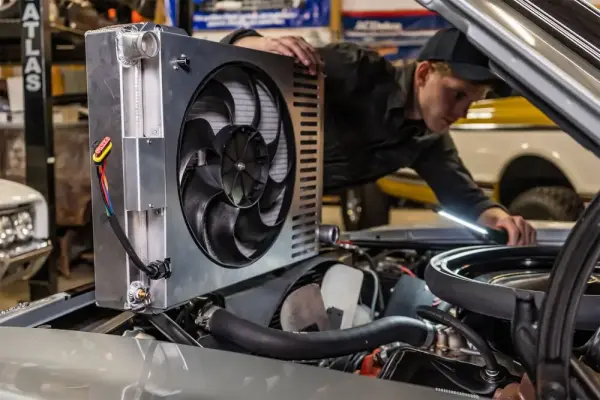
LS and small block Chevy swaps are extremely common now in classic cars and trucks. For most builders, engine fitment itself is no longer the intimidating part of the project. With today’s swap mounts and oil pan options, the drivetrain can usually be positioned where it needs to be for firewall and crossmember clearance without cutting up the car.
If you’re already sourcing swap components, it also helps to keep key fitment parts consistent, especially when brands like Proform Parts offer oil pans designed to work with these combinations.
The front of the engine bay is where most builds start getting tight.
Once the engine is in place, accessory drive spacing, water pump length, pulley depth, hose routing, LS steam port plumbing, and in some cases, turbo piping, all end up competing for the same limited space as the radiator, fan, and shroud. Older core supports were never designed around modern drivetrains, and that lack of space shows up quickly once everything is assembled.
That’s why slim-fit radiator systems exist. Not because builders forgot how to cool an engine, but because there often isn’t much room left to work with.
Why Fan and Shroud Space Becomes the Limiting Factor
A large number of cooling complaints after an engine swap happen at idle rather than at speed. That detail matters. When the vehicle is moving, airflow through the grille and radiator is largely handled by vehicle speed. At a stoplight or in traffic, the fan and shroud are responsible for pulling air evenly through the radiator, and spacing becomes critical.
Traditional cooling setups can consume a significant amount of front-to-back space when a radiator, fan, and shroud are selected separately. By the time everything is stacked together, there may not be enough room left to place the fan where it can work efficiently.
Proform’s Slim-Fit approach addresses that issue by integrating the radiator, shroud, and fan into a single assembly that remains about four inches thick in critical areas. Proform states this design can be up to forty percent thinner than typical radiator, fan, and shroud combinations.
Keeping total system depth under control allows the fan to sit where it can pull air evenly across the core instead of being pushed rearward or offset due to clearance limitations.
What “Slim-Fit” Means on Proform Systems
On Proform systems, Slim-Fit does not simply refer to a thinner radiator. It describes a complete cooling system that arrives fully assembled with the fan, shroud, and wiring harness already in place. The system is designed to solve both clearance and airflow challenges at the same time.
Several design choices support that goal. The fan motor is mounted directly to the core rather than hanging off the outside of the shroud, which helps reduce overall depth. Proform also incorporates a specially designed third tank to keep coolant flowing through the radiator and reduce dead space, using a brazing process intended to minimize leak potential.
The core itself uses a reinforced hybrid design that combines extruded tubes with traditional dual one-inch tubes.
Each system includes an OE-style inlet and outlet sizing and location, along with a weather-tight connector and harness. Proform also rates these systems for engines producing up to 600 horsepower, which places them well within the range of most street-driven LS and SBC builds.
When Slim-Fit Systems Matter Most in Real Builds
Slim-fit radiator systems make the most sense when a build is constrained by front-to-back clearance rather than radiator height or width.
This is common in classic muscle cars and trucks with fixed core supports, where radiator placement cannot easily be moved. It also shows up in LS swaps where modern accessory drives, water pump spacing, and pulley offset consume space that was once available for fan and shroud placement.
Boosted applications amplify the issue further, as turbo piping and charge routing reduce usable space at the front of the engine bay. Transmission choice can also play a role. Larger transmissions like the 4L80 often require careful drivetrain positioning to achieve tunnel and crossmember clearance.
Builders may use slider mounts or shift the engine location slightly, which directly affects how much room remains for the cooling system. In these cases, a thinner radiator and fan package can preserve options that would otherwise disappear.
Direct-Fit, Conversion, and Universal Slim-Fit Options
Proform does not treat every chassis the same. Slim-Fit radiator systems are offered in direct-fit, conversion, and universal configurations to match different build scenarios.
As an example, Proform lists Part #69600.4 for 1967–69 Camaro and Firebird LS conversions with automatic transmissions. This system combines the radiator, shroud, and fan into a package that is under four inches thick and includes features such as an LS steam port and a five-plate transmission cooler. For builders working on Chevelle applications, Part #69625.1 covers 1968–77 models with manual transmissions.
These options allow builders to choose a system that matches their chassis and drivetrain layout without forcing a one-size-fits-all solution.
Common Questions Around Slim-Fit Cooling
Many swapped vehicles run cool on the highway but struggle at idle. At speed, airflow through the radiator is provided naturally. At idle, cooling depends entirely on the fan and shroud pulling air evenly through the core. When fan placement is compromised due to limited space, idle temperatures tend to climb.
Radiator thickness alone does not guarantee better cooling. While additional thickness can increase heat capacity, it can also reduce the space needed for proper fan placement. In tight engine bays, poor airflow at idle can outweigh the benefits of a thicker core.
The main advantage of Proform Slim-Fit systems is total system depth control. By keeping the radiator, fan, and shroud integrated and compact, Proform aims to preserve airflow efficiency in engine bays where space is already limited.