
Ask ten gearheads what the harmonic balancer on the front of their crank actually does and you'll get some confident wrong answers. The name doesn't help. Here's what that heavy wheel on the crank snout is really doing, how to tell when it's failing, and what to do about it.
It's a Damper, Not a Balancer
Every time a cylinder fires, the power stroke twists the crankshaft. The crank isn't perfectly rigid, so it winds up slightly and springs back, over and over, hundreds of times a second. Those twisting oscillations are torsional vibration, and at certain RPM they hit resonant frequencies where the vibrations stack and amplify instead of canceling out.
The harmonic balancer is the part that absorbs that energy. A typical design bonds a heavy outer inertia ring to a center hub through an elastomer layer. The rubber lets the ring lag slightly behind the crank's oscillations, converting the vibration energy into small amounts of heat instead of letting it hammer the crankshaft.
Left uncontrolled, torsional vibration fatigues the crank itself, accelerates wear on main bearings and the timing set, loosens crank bolts, and in worst cases breaks crankshafts at the snout or the first main journal. The balancer is the only thing standing between the crank and those failure modes.
One exception worth knowing. On externally balanced engines like the small block Chevy 400 and pre-1989 big block 454, the balancer pulls double duty. It carries a counterweight that's part of the engine's rotating balance, which is why using the correct balancer for the application isn't optional. Put an internally balanced damper on a 400 small block and you've created a vibration problem worse than the one the balancer exists to solve.
How Balancers Fail
The elastomer layer is the wear item. Decades of heat cycles, oil exposure, and constant torsional stress harden and crack the rubber. The failure signs are worth committing to memory:
Cracked, bulging, or missing chunks of rubber between the hub and outer ring. A visual inspection with a flashlight catches this in thirty seconds.
The outer ring slipping or walking out of position. Sometimes visible as the ring sitting off-center or no longer flush with the hub.
Timing marks that seem to move. This one's sneaky, and we'll come back to it.
New vibration at specific RPM, unusual belt behavior, or a wobble visible with the engine running.
A separated balancer is genuinely dangerous. When the outer ring lets go completely at RPM, it becomes a heavy chunk of spinning iron leaving the engine at speed, and it takes the belts, the radiator, and sometimes more with it on the way out.
Why a Rebuild Should Include a New Balancer
On engine rebuilds, the balancer is one of the most commonly reused parts, and it shouldn't be. The elastomer in a 40 or 50-year-old damper has been degrading its entire life regardless of how it looks. Bolting a fresh rotating assembly to a tired damper puts the whole investment at the mercy of a rubber ring older than most of the people at the car show.
Our harmonic balancer lineup covers this exact situation with 100% new OEM replacement units in nodular iron, with degree markings included. For Chevy, that's the 6-3/4" small block balancer (Part #66510) and 8" small block balancer (Part #66511) for internally balanced engines, the 8" externally balanced unit for the 400 (Part #66513), and 8" big block units for the 396 (Part #66508) and pre-89 454 (Part #66512).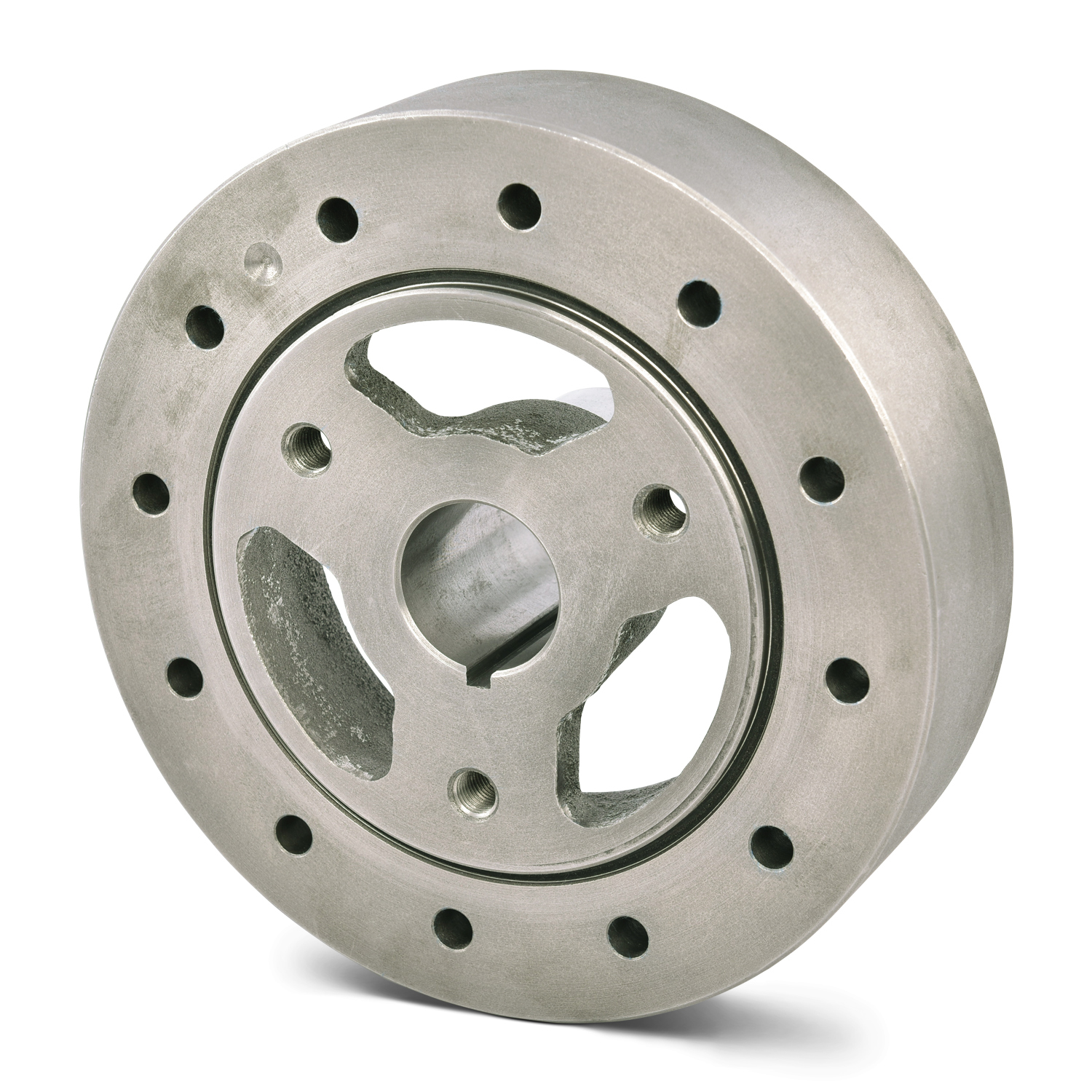
Mopar builders are covered too, with balancers for the Chrysler 360/5.9L from 1971-95 with the counterweight cut on the ring (Part #66506) and the Dodge Magnum 360/5.9L from 1994-2003 (Part #66507). Note these are two different balancers for what sounds like the same engine, because the LA-series and Magnum use different configurations. Application matching matters on the Mopar side the same as it does on the externally balanced Chevys.
New replacement pricing also eliminates the old ritual of cleaning, inspecting, and hoping with the original unit. These are affordable enough that reusing a questionable damper stops making sense.
The Timing Mark Problem Nobody Catches
Here's the failure mode that fools even experienced tuners. The timing marks on a typical balancer are etched into the outer inertia ring. As the elastomer ages, the ring can slip in relation to the center hub, which moves the etched marks away from true Top Dead Center. Your timing light is now reading marks that are lying to you, and every timing adjustment made from them is wrong by however far the ring has walked.
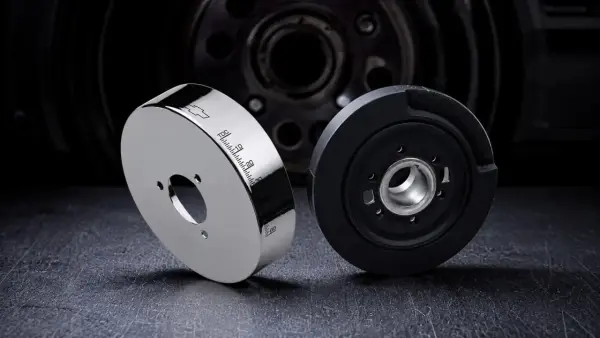
Our patented balancer covers (U.S. Patent 5,675,078) solve this directly. The cover mounts through the center hub, not the outer ring, so its degree markings from 60 BTDC to TDC stay accurate regardless of any ring slippage. They also replace the timing tapes that inevitably fling off, improve readability under a timing light, and dress up a part of the engine bay nobody ever thinks about, with the look of a $200 balancer.
Covers are available for small block Chevy with the 6-3/4" damper in chrome (Part #141-725) and black (Part #141-727), small block with the 8" damper (Part #141-728), and big block with the 8" damper in chrome (Part #141-729), all officially licensed Chevrolet Performance products with the Bowtie emblem.
Install It Right or Don't Bother
A balancer is an interference fit on the crank snout, and the two classic installation mistakes both destroy parts. Hammering a balancer on transfers impact through the crank to the thrust bearing. Pulling one off by the outer ring separates the ring from the hub and ruins the balancer.
The correct tools thread into the crank and press the balancer on and off through the hub. Our harmonic balancer installation tools cover SBC and BBC, GM LS, late-model Ford, Chrysler, and Pontiac, Buick, and Olds applications, and we covered how to use them in our engine building tools guide.
Every PROFORM Balancer Is 100% New
Not remanufactured, not a refurbished core. Every balancer in our lineup is built from 100% new components, because the entire point of replacing a damper is eliminating unknown wear history, and a reman unit puts it right back.