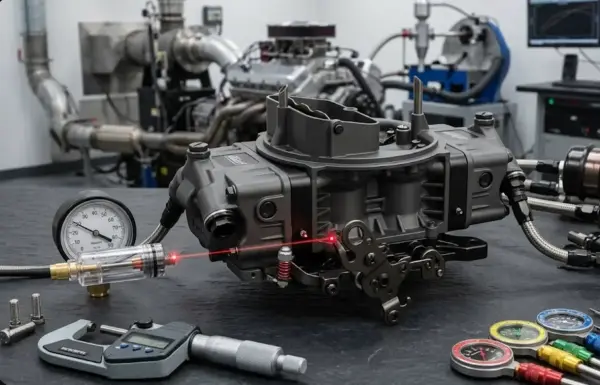

How to tune a carburetor is one of those skills that separates a car that runs from a car that runs right. A new carburetor out of the box is calibrated for a generic application. Once it is bolted to your specific engine with your specific cam, headers, gearing, and altitude, the calibration almost always needs adjustment.
The good news is carburetor tuning is mechanical, predictable, and reversible. Every change you make is a screw turned, a jet swapped, or a spring changed. Nothing is permanent, and nothing requires a laptop.
Every complete PROFORM carburetor is hand assembled and dyno tested before it ships, so the baseline you're tuning from is a known quantity. Here is how to work through it in order.
How to Tune a Carburetor the Right Way
A carburetor's job is to deliver the right fuel for every operating condition. Idle, off-idle transition, cruise, acceleration, and wide-open throttle each use a different fuel circuit inside the carburetor, and each circuit has its own adjustment.
An out-of-tune carburetor shows its symptoms clearly. Rough idle. Hesitation off the line. Loading up or going lean at cruise. Bog when the secondaries open. Each of those is a clue pointing to a specific circuit that needs attention, which is what makes tuning a diagnostic skill rather than guesswork.
The point of tuning is not just making more power. A well-tuned carburetor makes the car start easier, idle smoother, respond better to throttle input, get better fuel economy at cruise, and pull cleanly through the upper RPM range.
That is why the order matters. The idle circuit affects how the off-idle circuit behaves. The off-idle circuit affects how the main circuit transitions in. The main circuit feeds into the power valve and secondaries. Get any of the early steps wrong and every adjustment after it is built on a shaky foundation.
The adjustments in this guide rely on tunable hardware. PROFORM carburetors are built around adjustable screw-in air bleeds, fully adjustable billet metering blocks, and carburetor accessories that make every step here accessible.
Setting a Clean Baseline Before You Tune
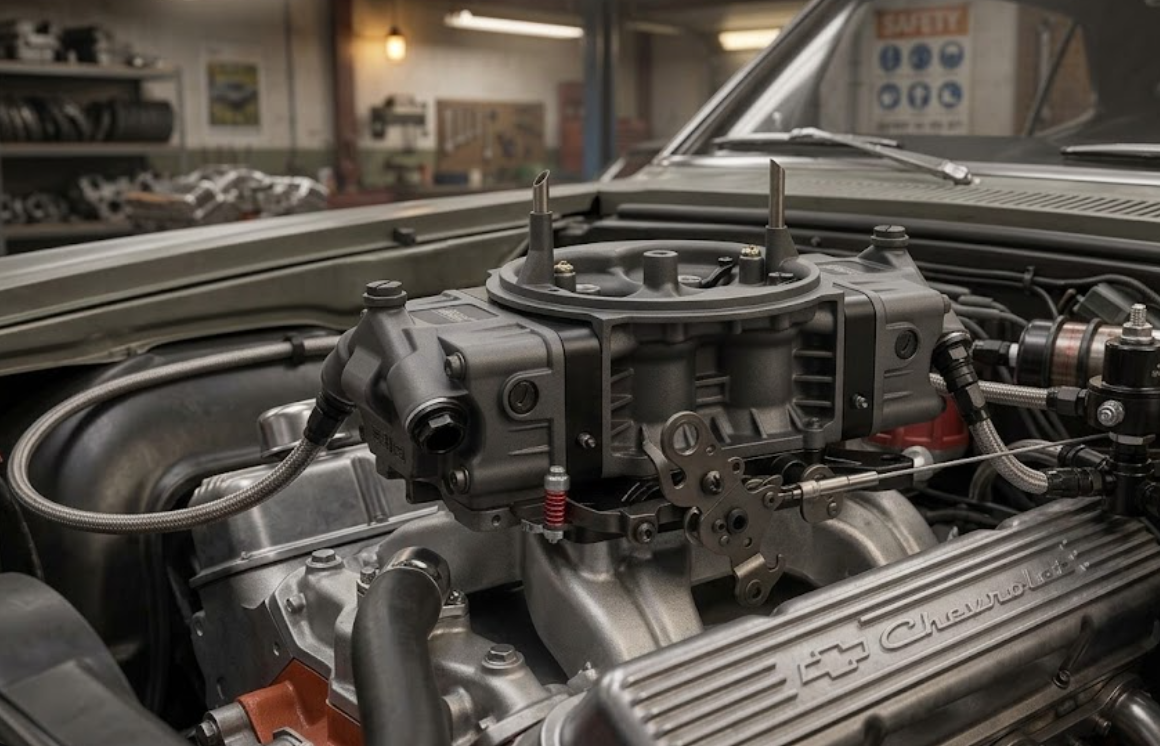
Carburetor tuning starts with everything else being right. A carburetor cannot compensate for ignition timing that is off, vacuum leaks, or fouled spark plugs.
Before touching a single carb adjustment, set initial ignition timing to the engine's recommended spec, confirm there are no vacuum leaks at the intake or base plate, verify the spark plugs and wires are healthy, and check that the fuel system is delivering steady pressure within the carburetor's spec range. Bring the engine to full operating temperature before making any adjustment.
Tuning a cold engine, or tuning over a vacuum leak, will lead you in circles. Get to a clean baseline first.
Idle Mixture and Idle Speed
This is the foundation. Idle mixture screws control the air-fuel ratio at idle, and idle speed sets the curb RPM.
Start with the idle mixture screws turned out about one and a half turns from fully seated as a baseline. With the engine warm and running, slowly turn each screw in until the idle drops, then back out until it just begins to drop again. The position between those two points, which corresponds to the highest vacuum reading on a gauge, is where the mixture is dialed in.
Idle speed gets set last. With the mixture dialed in, adjust the curb idle screw until the engine sits at the RPM you want, typically 750 to 900 for a street performance build, depending on the cam.
If you cannot get a stable idle no matter where the mixture screws are, the cam is likely too big for the idle circuit to compensate, or there is still a vacuum leak somewhere. Four corner idle systems and changeable idle feed restrictions expand the adjustment range for aggressive camshaft profiles. Otherwise, stop and check the basics again before moving on.
Accelerator Pump for Throttle Response
The accelerator pump squirts a measured shot of fuel into the throat of the carburetor every time the throttle opens. Its job is to cover the brief moment between throttle opening and the main circuits taking over.
A bog or stumble when you crack the throttle usually means not enough pump shot. A rich black-smoke puff means too much. The pump shot has two variables you can adjust, which are the size of the squirter (the orifice the fuel comes out of) and the cam (the linkage profile that controls how much fuel and how quickly).
Squirters and cams come in a range of sizes and profiles. Bigger squirter means more fuel and faster delivery. A different cam changes shot duration. PROFORM carburetors use torx head squirters, so swapping sizes is quick work with the right driver. Adjust from the factory baseline based on how the engine actually responds to throttle input on the road.
Jets for Cruise and Mid-Range Fueling
Jets meter fuel into the main circuit, which is what feeds the engine at part-throttle cruise and through the mid-range. Primary jets handle the primary throttle bores, secondary jets handle the secondaries.
Reading spark plugs after a run is the traditional way to check jetting. A tan or light brown plug color means the mixture is in the right range. White or chalky means lean, which calls for a larger jet. Black or sooty means rich, which calls for a smaller jet.
Altitude affects jetting significantly. A carburetor calibrated at sea level will run rich at elevation, since the air is less dense. Plan for that when tuning a build that lives at different altitudes or travels between them.
Power Valve and Wide-Open Throttle
The power valve adds extra fuel to the main circuit when manifold vacuum drops below a set threshold, like when the throttle is wide open under load. It is essentially a vacuum-triggered enrichment circuit.
Power valves are rated by the vacuum level at which they open. A 6.5 power valve opens at 6.5 inches of vacuum, a 4.5 opens at 4.5, and so on. The right value depends on what your engine pulls at idle in gear and under load. The general rule is to pick a power valve that opens at about half your idle vacuum reading.
A power valve that opens too late leaves the engine lean at the top of the RPM range. One that opens too early adds fuel when the engine does not need it and hurts economy.
Tuning the Secondaries
Secondaries feed the engine through the upper half of the RPM range, and how you tune them depends on how they open.
On a mechanical secondary carburetor, which is what every complete PROFORM carburetor uses, the secondaries open based on linkage position. That puts the timing in your hands. Secondary jet sizing and the secondary side of the fuel curve become the main adjustment points, and the opening rate itself is adjustable. PROFORM carburetors offer easy access secondary air flow adjustment without special tools or pulling the carb, and the opening rate can be tuned with a linkage kit sold separately.
The symptom to tune against is the bog. Secondaries that come in before the engine can use the airflow cause a stumble at the hit. Delay the opening or adjust the secondary fueling until the transition is clean and the pull is seamless.
Why PROFORM Carburetors Skip the Choke
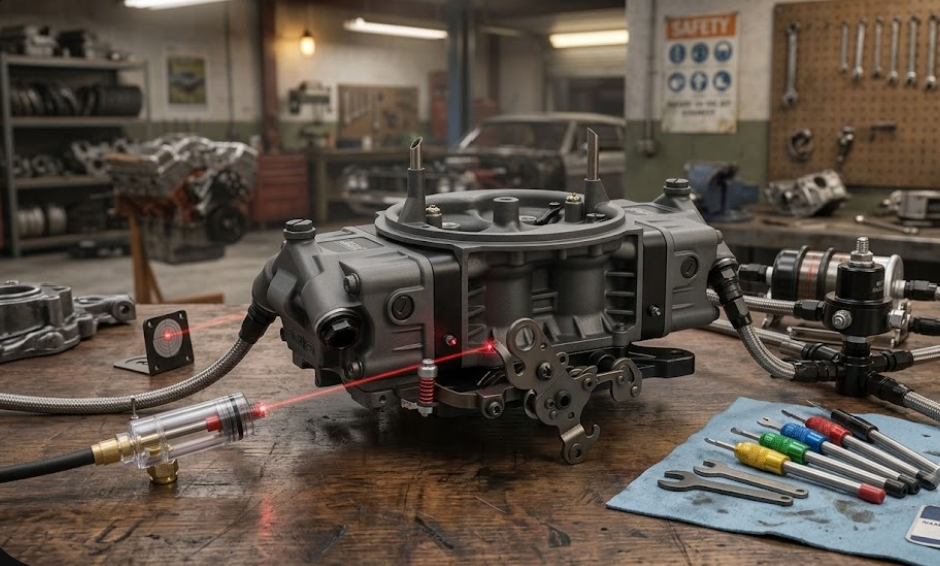
Every complete PROFORM carburetor is built without a choke, and if you're used to tuning one, that's one less circuit on your list.
A choke exists to enrich the mixture for cold starts on a daily driver that has to behave on the first crank. A performance build doesn't operate that way. A street strip car gets a proper warm-up before it's asked to work, and a strip car is warmed up before it ever stages.
Deleting the choke also pays off at the tuning bench. No choke tower means a cleaner casting and maximum airflow through the primary side, and one less vacuum leak point to chase when you're hunting an idle problem. That's one whole category of cold-start diagnosis and adjustment you simply never have to do.
Why a Quality Carburetor Makes Tuning Easier
Tuning is more straightforward when the carburetor you start with is built to consistent tolerances. A carburetor with sloppy machining or out-of-spec parts fights every adjustment you try to make, since the starting point itself is unreliable.
Every complete PROFORM carburetor is assembled with 100% new components, hand assembled, and dyno tested in the U.S.A. before it ships. Billet aluminum metering blocks, a billet throttle base plate that won't warp, and adjustable screw-in air bleeds mean the adjustments described in this guide are all accessible without drilling permanent changes into the calibration. The carb you bolt on starts in a known, consistent state, and that is a carb you can dial in confidently.