What Corner Weight Scales Actually Tell You About Your Race Car Setup
Wednesday, March 11, 2026
If you've ever watched a professional race team work through tech inspection or a pre-race setup session, you've seen the car sitting on four individual scale pads while the crew huddles around a display. Corner weighting is one of the most fundamental tuning steps in motorsport, but it's often skipped at the club and amateur level simply because most builders don't own scales. That's a mistake, because no amount of eyeballing suspension geometry can replace actual numbers.
Here's what those numbers mean and what you can do with them.
Corner Weight vs. Total Weight
Total vehicle weight is straightforward, you want to know you're legal for your class, and you want to know what your suspension and tires are actually carrying. But total weight only tells part of the story. Corner weight is where setup actually lives.
Each corner of your car carries a percentage of the total weight. In a perfectly balanced world, you'd want equal loading front-to-rear and side-to-side for your specific application. In reality, every car is different, every driver is different, and the "ideal" distribution depends on whether you're running oval, road course, drag, or autocross.
Cross Weight and Why It Controls Handling Balance
Cross weight, sometimes called wedge, is the relationship between diagonally opposite corners of the car. Specifically, it's the combined weight of the left front and right rear corners expressed as a percentage of total vehicle weight.
A 50% cross weight means those two diagonal corners carry exactly half the total load. That's the baseline for a neutral-handling car on a symmetric track like a road course or autocross course. Push the cross weight above 50% and the car will tend to tighten up (push) in left-hand turns. Drop it below 50% and the car loosens up (oversteer tendency in left turns).
On oval tracks, teams intentionally run cross weights well above 50% because all the significant cornering loads are in left-hand turns. The wedge helps the car hook in and maintain consistent handling lap after lap.
Side-to-Side Weight Distribution
Side-to-side percentage shows how the car splits weight across the centerline. On a road course car, you generally want this as close to 50/50 as possible for balanced turn-in response in both directions. On an oval car, running more weight on the left side (closer to the inside of the turns) helps handling, which is why you'll see setup sheets showing 55-58% left side weight on some late model and modified classes.
For street/strip cars and bracket racers, side-to-side balance affects 60-foot times and straight-line stability. An unbalanced car will load one rear tire harder than the other off the line, and that inconsistency shows up in your ET spread.
Front-to-Rear Distribution
Front-to-rear percentage affects grip balance under braking and acceleration, nose dive characteristics, and how the car responds to aerodynamic input at speed. A drag car lives toward the rear-heavy side to maximize traction. A road course car tuned for trail braking wants more front bias than you'd expect.
Knowing your actual front-to-rear split, not just guessing based on where the engine sits, lets you make informed spring rate, shock setting, and ballast decisions instead of chasing a handling problem through trial and error.
How You Adjust Corner Weights
Once you have your baseline numbers, corner weights are adjusted primarily through ride height, specifically by changing spring perch height or threaded collar position on coilovers. Raising a corner increases the load on the diagonally opposite corner. Lowering it does the reverse.
This is why re-checking scales after any suspension adjustment matters. Changing the right rear ride height, for example, doesn't just affect right rear weight, it affects cross weight and front-to-rear distribution simultaneously. Without scales you're flying blind through that process.
Ballast placement is the other major lever, especially on purpose-built race cars where the rules allow it. Knowing your actual corner numbers tells you exactly where additional weight will have the most impact.
Go-Kart Scaling Isn't Different in Principle
The same physics apply at the karting level, just with much tighter tolerances and a simpler chassis to work with. Karts flex intentionally as part of their handling design, and the seat position, caster, and axle stiffness choices all interact with corner weight. Serious kart racers scale as a matter of routine, not an afterthought.
Getting Your Own Scales
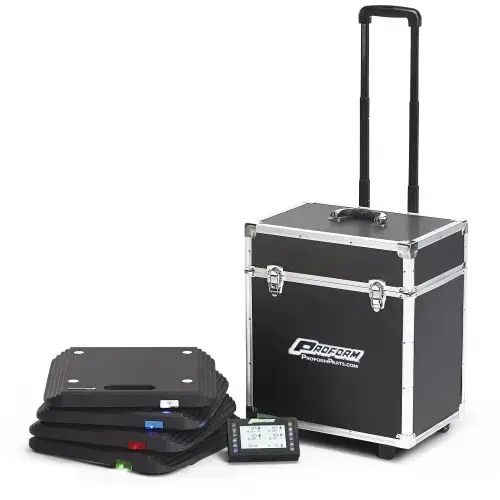
For anyone running a dedicated race car, owning a set of scales removes a massive variable from the setup process. PROFORM's vehicle scales are built for exactly this use case, their 7,000 lb. wireless system uses full-size 15x15" aluminum scale pads (1-5/16" thick with a drive-up ramp angle for easy positioning), displays cross weight, side-to-side, front-to-rear, and individual corner percentages simultaneously, and streams live data via USB to a PC for logging and export. The hard case with wheels makes it practical to bring to the track rather than leaving it in the shop.
For lighter applications, the 5,000 lb. wired system offers accuracy to 1/10 of 1% with an oversized LCD display and color-coded 20-foot cables so you're not guessing which pad is which. For karts, the 1,200 lb. wireless go-kart system is purpose-sized for the application.
If you're putting serious money and time into a build, a set of scales pays for itself the first time you find a significant cross weight imbalance you didn't know was there.