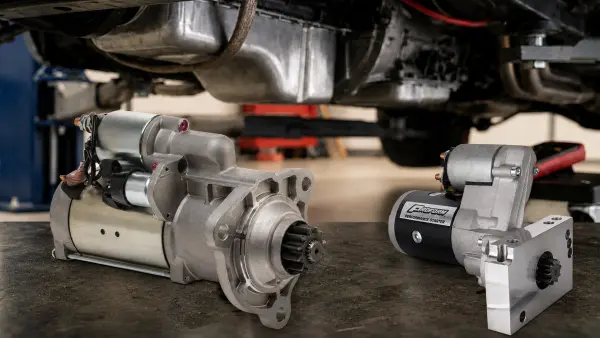

If you've priced starters for a classic V8 build, you've seen both options. The traditional full-size starter that looks like what came off the engine, and the compact mini starter that costs a bit more and looks almost too small for the job. The size difference makes some builders suspicious. It shouldn't. The mini starter is smaller because it works smarter, not because it does less.
How a Regular Starter Works
A stock-style starter is a direct-drive design. The motor's armature connects to the pinion gear at essentially a one-to-one relationship, so the motor has to be large and slow-turning to produce enough torque to crank the engine. That's why regular starters are big, heavy, and hungry for current.
The design worked fine for the engines it was built around. A 60s or 70s production V8 running 8.5:1 or 9:1 compression doesn't take much effort to spin. But direct drive has no leverage in reserve. As compression climbs, cranking load climbs with it, and the only answer a direct-drive starter has is to pull more current, which generates more heat, which is exactly why tired stock starters click and drag on hot restarts.
How a Mini Starter Works
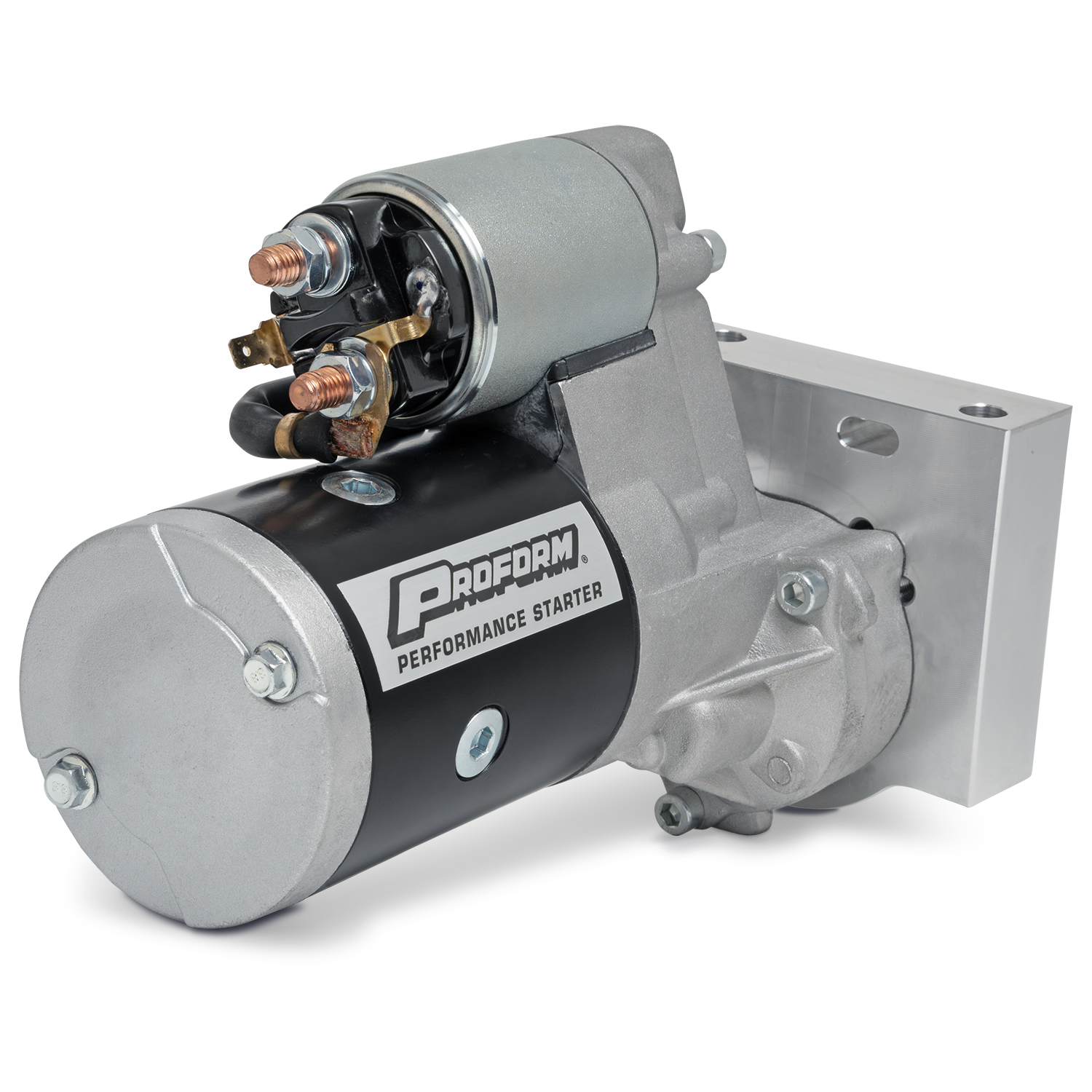
A mini starter flips the approach. Instead of a big, slow motor driving the pinion directly, it uses a smaller, faster-spinning motor working through a sealed gear-reduction drive. PROFORM High-Torque Mini Starters use a 3.75-to-1 reduction, meaning the motor spins 3.75 times for every rotation of the pinion gear, and that mechanical leverage multiplies torque the same way a low gear multiplies torque at the rear axle.
The result is a starter that delivers 40 to 50 percent more cranking power than a stock starter while drawing less current, weighing less, and occupying a fraction of the space. Our units run full ball bearing construction, billet aluminum mounting plates, and an offset design that creates additional clearance between the starter and the oil pan. Many models can also be rotated for additional chassis clearance, which matters on swaps and header-equipped builds where the stock starter position fights everything around it.
The Compression Ratio Question
This is where the choice stops being about preference and starts being about necessity.
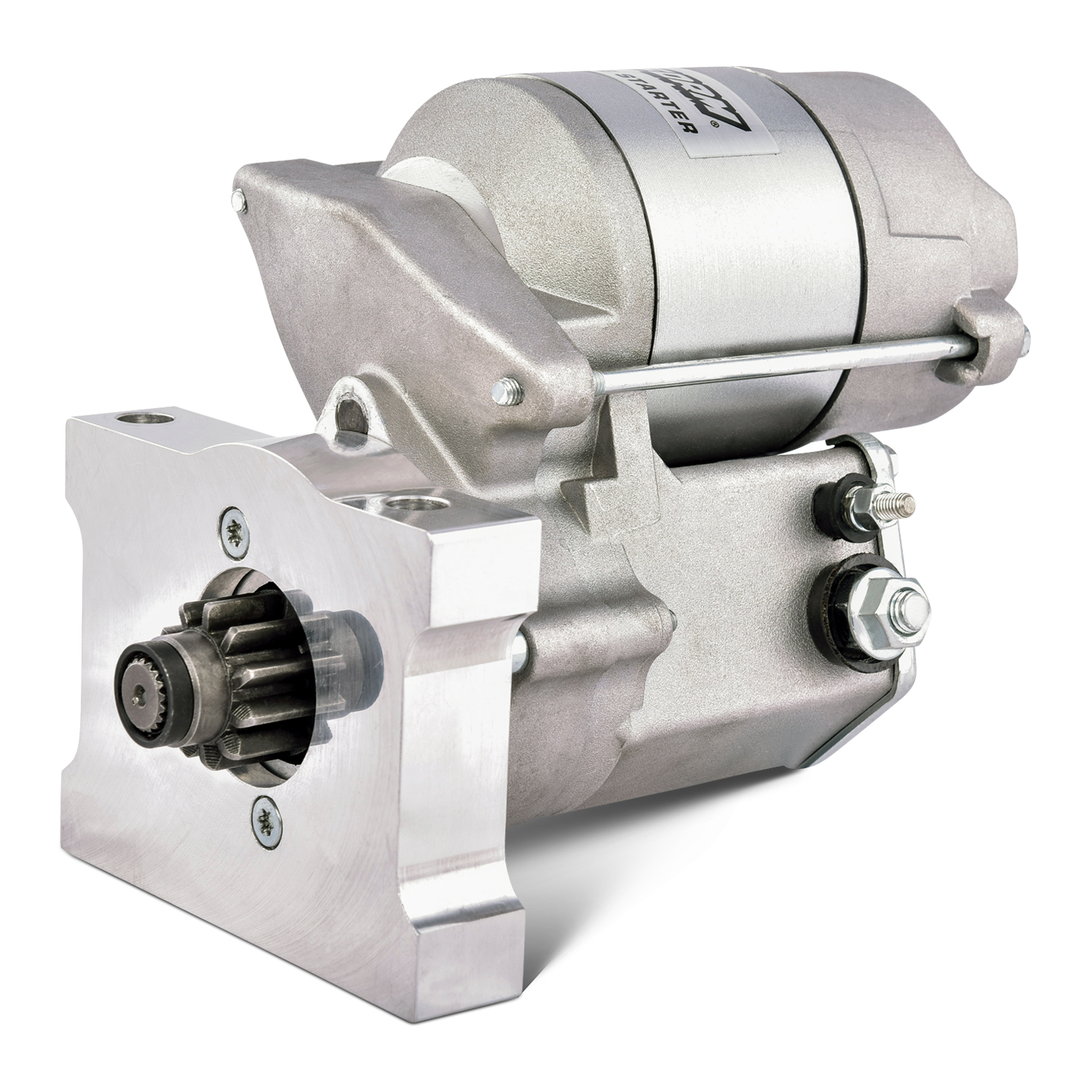
Every PROFORM starter carries a maximum compression ratio rating. Our 1.4KW Chevy high-torque starter (Part #66256) handles engines up to 11:1, which covers most street performance builds. Our 2.2KW Chevy unit (Part #66258) is rated for 15:1, built for serious compression. LS builders get the same 15:1 capability in the GM LS high-torque starter (Part #66277), which fits LS1, LS2, LS6, and LS7 engines.
For the biggest compression numbers, our Race Series starters step up from the 3.75:1 reduction to a 4.41:1 gear reduction. The Pontiac and Oldsmobile Race Series unit (Part #67053) fits 1965-1982 V8s and is built for engines up to 14:1, with every unit individually tested at the factory after assembly.
A regular starter has no answer to any of this. Put a stock-style starter on a 13:1 engine and you'll hear the result on every hot start.
Weight and Clearance
A full-size stock-style starter adds substantial mass low on the block. PROFORM's compact starters reduce that burden; for example, the P/N 66268 stock-replacement mini starter weighs 8.3 pounds. That's real weight off the car in a location where nothing good comes from carrying extra.
Clearance is the other half. Long-tube headers and deep-sump oil pans routinely conflict with a full-size starter's housing. The compact case and offset design of a mini starter solves problems a regular starter creates. One honest note that applies to any starter purchase: even a midsize unit can have clearance issues with select header and oil pan combinations, so check your specific setup before ordering. That's true of every brand, and it's why we publish the note on our own product pages.
When a Regular-Style Starter Still Makes Sense
If the build is a numbers-matching restoration where originality is the whole point, the stock starter belongs there. That's about correctness, not performance.
For everything else, including a bone-stock daily driver that just needs a replacement, the math favors the mini. Our Part #66268 stock replacement starter is the proof. It's a gear reduction mini with a 1.7KW motor and staggered mount for 168-tooth flywheels, rated for 10:1 compression, priced and positioned as a straight replacement. Even at replacement grade, the gear reduction design is simply the better way to build a starter.
Getting the Fitment Right
Three things determine which starter fits your engine. Flywheel tooth count, which for Chevy applications means 153 or 168 tooth (our high-torque Chevy units fit both). Mounting style, either inline or staggered bolt pattern. And on Ford applications, transmission type, since our Ford 221-351W units are specific to automatic or manual transmissions.
Shims to set pinion gear engagement are included with our high-torque starters when needed, and our lineup covers Chevy small block, big block, and V6, GM LS, Ford, Pontiac, Oldsmobile, Buick, and Chrysler applications.
Every PROFORM Starter Is 100% New
Not remanufactured, not a rebuilt core in a fresh housing. Every starter we build uses 100% new components, full ball bearing construction, and is approved by leading sanctioning organizations. A starter is the part you need to work every single time with no drama, and a unit with unknown wear history under the paint is a gamble that saves almost nothing.
If you're not sure which starter matches your compression ratio, flywheel, and clearance situation, contact us and our team will point you to the right part number.