How to Diagnose a Starter That Clicks, Drags, or Won’t Crank
Key Takeaway: Starter problems announce themselves in a handful of distinct symptoms, and each one points to a different component. A single click with no crank usually means the solenoid or a voltage supply problem. Slow, labored cranking points to heat soak, a tired motor, or a starter overmatched by the engine's compression. A starter that spins without turning the engine means the clutch drive. Grinding means the pinion gear or engagement depth. Work the symptom, not the guess, and you replace the right part the first time.
A starter that acts up always picks its moment. The good news is that starters fail in predictable ways, and the noise the car makes, or doesn't make, tells you most of what you need to know before a wrench comes out.
Here's how to read the symptoms.
One Click, No Crank
You turn the key, hear a single solid click, and nothing else happens. The click is the solenoid plunger engaging, which confirms the solenoid is receiving a start signal but does not confirm the high-current side is healthy. What's missing is either the heavy current to spin the motor or a solenoid whose contacts have burned to the point they can't pass that current.
Check the simple things first. Battery voltage, battery terminals, and the ground path between the engine and the chassis. A corroded ground strap causes more no-crank conditions than actual starter failures do. If voltage checks out at the starter's main terminal during the crank attempt and you still get click-no-crank, the solenoid contacts are the prime suspect.
On a PROFORM starter, that's a part, not a whole new unit. Our replacement starter solenoid (Part #66256S) fits our high-torque starter line, so a burned solenoid is an afternoon fix instead of a full replacement.
Rapid Clicking
A machine-gun click is a different diagnosis than a single click. Rapid clicking is the solenoid engaging and dropping out over and over because there isn't enough current to hold it in while also feeding the motor. That's a battery or connection problem almost every time. Charge the battery, load test it, and clean every connection in the starting circuit, including the grounds, before condemning any starter component.
Slow, Labored Cranking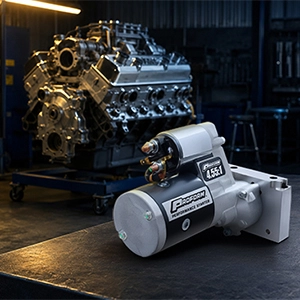
The engine turns but sounds like it's wading through mud. Three causes cover most cases.
Heat soak is first, and it's most common on header-equipped cars. Starter motors lose efficiency as they heat up, and a starter living inches from a header tube gets brutally hot on a long drive. If the engine cranks fine cold but drags on hot restarts, that's the pattern. A gear reduction starter resists this better than a stock-style unit because it draws less current to begin with, and its compact case is easier to position away from the heat.
An overmatched starter is second. If the engine has been rebuilt with more compression than it left the factory with, the original-spec starter may simply not have the torque. This is a matching problem, not a defect. Our high-torque starters carry compression ratings from 10:1 on the stock replacement mini up to 15:1 on the 2.2KW units, so the fix is picking the rating that matches the build.
A dying motor is third. Worn brushes and bushings show up as gradually slowing cranking over months. On most starters, that's the end of the road.
Starter Spins, Engine Doesn't Turn
You hear the motor whir freely, but the engine never moves. That's the one-way clutch drive. The clutch is what lets the pinion drive the flywheel during cranking, then freewheel the instant the engine fires so the running engine can't back-drive the starter to destruction. When the clutch wears out, it freewheels in both directions, and the starter spins uselessly.
On our high-torque starters, the replacement clutch pack (Part #66256CL) services exactly this failure, fitting the full range of our Chevy, Ford, Pontiac, Olds, and Buick high-torque units.
Grinding on Engagement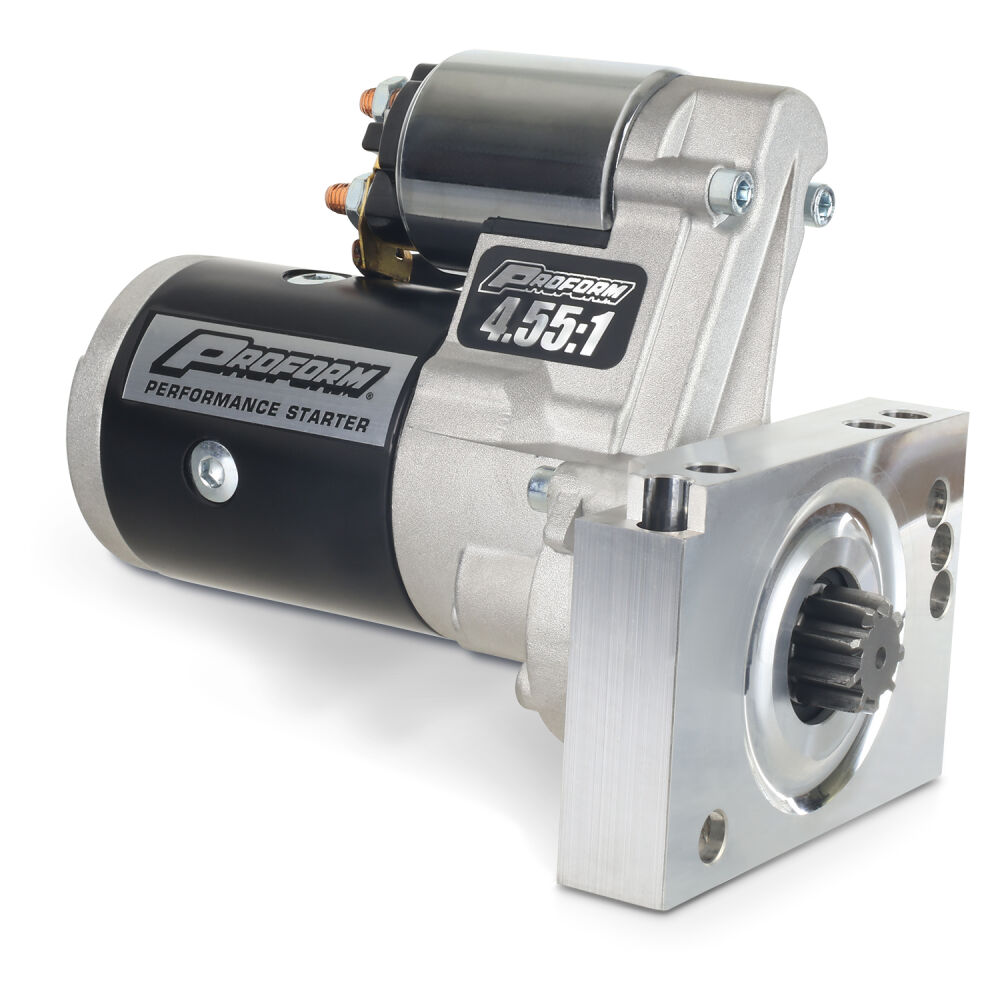
A grind when the starter kicks in means the pinion gear and the flywheel ring gear aren't meshing cleanly. Two common causes, and it's worth getting this diagnosis right because the wrong guess eats a ring gear.
If the grind appeared gradually, pull the starter and look at the pinion teeth. Chewed, rounded, or chipped teeth mean the pinion is done. Our replacement starter pinion (Part #66256P) restores the drive end, and the spring and clip kit (Part #66256SS) covers the pinion's engagement hardware at the same time. While you're in there, inspect the flywheel ring gear too, because a worn pinion and a worn ring gear usually happen together.
If the grind showed up immediately after installing a starter, the engagement depth is wrong. That's what shims are for. The starter shim kit (Part #66256SH) sets the pinion-to-ring-gear clearance on Small- and Big-Block Chevy installations, and our high-torque starters include shims for exactly this reason. Proper engagement depth is the difference between a starter that lasts years and one that grinds itself to death in a season.
Test Without the Key Dance
Diagnosing any of this solo means running between the driver's seat and the engine bay over and over. Our remote starter switch (Part #67406) ends that. It's a universal 12-volt switch that lets you crank the engine from under the hood, so you can watch the starter engage, listen to the pinion mesh, and check voltage at the terminals while it happens. For setting shim depth or chasing an intermittent click, it's the tool that makes one person as effective as two.
Serviceable Beats Disposable
Many replacement starters are treated as complete-unit replacements when an internal component fails. When one component fails, the whole starter gets replaced. Every PROFORM high-torque starter is built from 100% new components to begin with, and the solenoid, clutch pack, pinion, engagement hardware, and shims are all available as individual service parts. Diagnose the actual failure, replace the actual part, and keep the starter in service.
If you've worked through the symptoms and aren't sure which part your situation points to, contact us and our team will help you sort it out.
|